


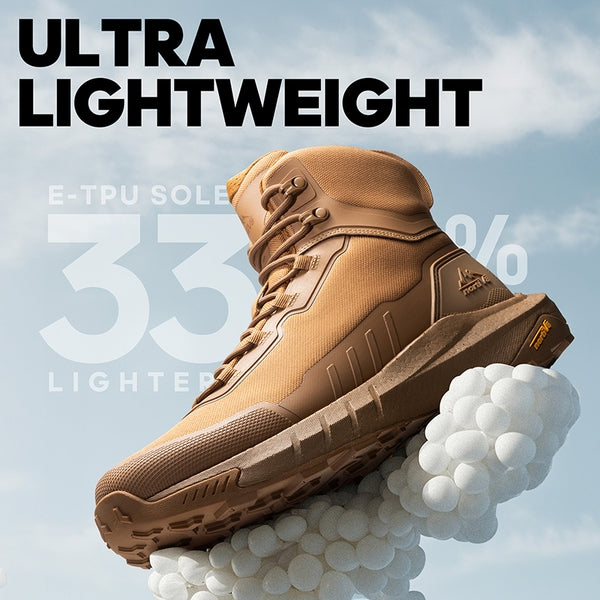
Cushioning built in, not bolted on
An E-TPU sole with real rebound, so you're not stacking insoles into a boot that was never built to cushion you in the first place.
- 62% rebound against roughly 40% for standard foam, built into the sole itself
- About a third lighter than a standard sole, so hour eight doesn't wear you down
- Side zip plus a full lace-up front, so you can dial in the fit instead of accepting whatever the box shipped in
- Oxford fabric upper built to resist abrasion instead of wearing thin in the first month
You've already tried to fix this
The heat-molded insoles. The men's sizing, because the "women's" options ran too narrow through the toe. Maybe two or three brands before this one, because someone on the crew swore by them.
And by hour four, your feet still ache. Not because you haven't tried, but because every fix you've reached for has been the same fix, stacked a little differently: more padding on top of a boot that was never built to absorb the impact in the first place.
An insole that flattens out in a couple of days was never going to solve a problem that starts in the sole underneath it.
The cushioning is in the sole, not on top of it
A foam insole compresses fast. Standard EVA foam is like a couch cushion that's been sat on too many times, it feels fine on day one and goes flat within days of a full shift.
Groundspring Rebound builds the cushioning into the sole itself. The E-TPU material holds roughly 62% of its rebound, compared with about 40% for standard foam, so the give-back doesn't disappear after a few wears.
A side zip and full lace-up front let you dial in the fit. Instead of settling for whatever width the boot happened to ship in, you can actually adjust it.
Built different, not just marketed different
"I go through a pair of boots every few months on site. These are the first ones that still feel like day one after weeks of real wear."
Jordan R., HVAC installer
"I used to size up into men's just to get enough room. These actually fit without feeling like I borrowed someone else's boots."
Casey M., apprentice electrician
"Felt like the same kind of cushioning as a much pricier pair I almost bought instead, for less than half the price."
Amara T., construction crew
"No camo, no bulk, just a boot that doesn't look like it's trying too hard. My crew didn't even clock that they were new."
Priya S., framing crew
Cushioning that doesn't flatten
Add-on insoles wear out because they're asking a thin layer of foam to do a job the sole should be doing. The E-TPU midsole is built into the boot itself, so the rebound is still there on week six, not just day one.
A fit you can actually adjust
The side zip gets you in and out fast, and the full lace-up front lets you tighten or loosen it exactly where you need to, instead of living with whatever width the box shipped in.
Built for the shift, not just the box
The Oxford fabric upper is built to resist abrasion, so it's not wearing thin at the toe and ankle in the first month the way a lot of budget uppers do.
Before Groundspring Rebound, and after
What's actually different underneath
E-TPU sole instead of standard foam
Most work boots use standard EVA foam, which starts compressing within the first few wears. Groundspring Rebound uses E-TPU, holding roughly 62% of its rebound versus about 40% for standard foam.
About a third lighter
Less weight on your foot means less fatigue by the time you're eight hours into a shift that's already long.
Oxford fabric upper
Built to resist abrasion instead of wearing thin at the toe and ankle within the first month, the way a lot of budget uppers do.
Side zip plus full lacing
Fast on and off from the zip, and a real fit adjustment from the laces, instead of one or the other.
Priced like it should be
The kind of sole upgrade some brands charge twice as much for, at $49.99.
Groundspring Rebound vs. the usual options
| Groundspring Rebound | Typical work boot | Add-on insoles alone | |
|---|---|---|---|
| Where the cushioning lives | Built into the E-TPU sole | A thin foam insole dropped in at the factory | Whatever you can add after the fact |
| Rebound | 62% | Roughly 40% (standard foam) | Drops fast within the first days of wear |
| Weight | About a third lighter than a standard sole | Standard sole weight | Adds bulk inside an already-snug boot |
| Fit adjustment | Side zip plus full lace-up | Laces only, in most cases | No change to how the boot itself fits |
| Typical price | $49.99 | Often $100 to $180 and up | $15 to $40, repeatedly |
One pair. $49.99. No catch.
One pair of Groundspring Rebound boots with the E-TPU sole built in, backed by our guarantee.
Before you order
I've bought boots that were supposed to fix this before and they didn't. What's actually different here?
Will these look too tactical or military for regular site wear?
Do these run true to size?
Will my current insoles or orthotics still fit inside these?
How do I know these will actually hold up longer than my last pair?
What if they don't work out for my shift?
How long does shipping take?
What's your return policy?
What sole material is this, exactly?
What people are saying
"Finally not fighting my boots by 2pm."
Dana K.
"Zipper is a small thing that matters more than I expected."
Renee O.
"Lighter than my old pair right out of the box."
Miguel A.
"Ordered my usual size, fit exactly as expected."
Taylor B.
Stop patching the pain with another insole
Groundspring Rebound builds real cushioning into the sole itself, so you're not starting over with something new every few weeks. $49.99, backed by a 90-day guarantee.